The Storage Box Trap: Why More Sorting Can Make Things Harder to Find
The storage box trap starts when every category gets another container. Learn how to make stored belongings visible, limited and easier to find without buying more.
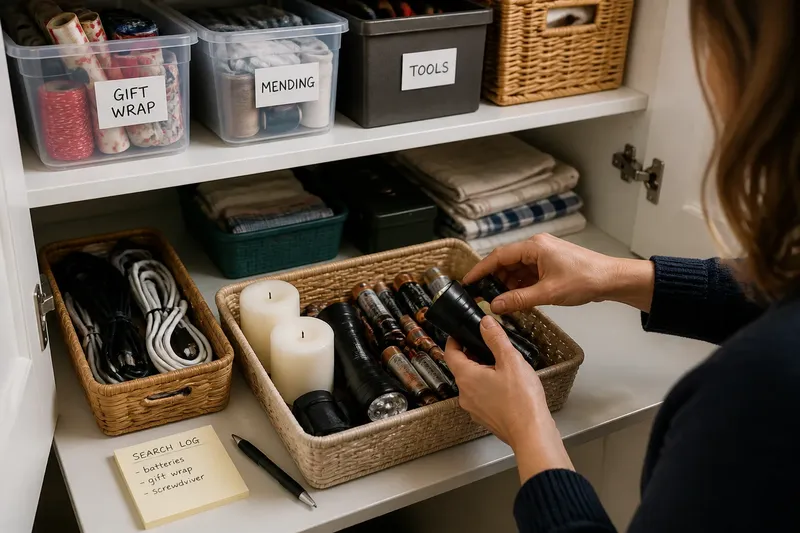
The common storage box trap is buying another container before checking why an item is hard to find. It can cost you time, hide useful belongings and split one category across several places. A better arrangement starts with the search that keeps going wrong, not a fresh stack of tubs.
Storage box trap clues
Notice the last few things you struggled to locate. Was it a torch, spare batteries, gift wrap or the screwdriver you reach for? Each search points to a practical question: are similar items scattered, hidden behind other belongings, or stored under a label too broad to help?
Choose one cupboard, drawer or shelf. Keep a scrap of paper nearby and jot down the item you looked for and where you expected it to be. This is a small record of mismatches, not a household inventory.
Clear a tray or a small patch of floor for sorting. Avoid using a surface you need for meals or work unless you can clear it straight away. Keep walkways open, especially if the items include tools or small parts.
Group by use
Put together the things you would naturally search for in the same place. Gift wrap, tags and tape may belong together because they serve one task. Needles, thread and small scissors may form a basic mending group, while spare buttons might belong with wider sewing supplies if that is where you would look.
Keep categories broad enough to avoid giving every handful of objects its own box. Split a group only when its contents have a distinct use or belong near another activity. A label should help someone find and return an item, not describe your sorting method.
Set a physical limit using space you already have: one drawer, a shelf section or an existing box. If the group does not fit, check for duplicates, unrelated items or belongings that belong elsewhere before adding another container. Decide what to keep based on use and condition; do not force everything into the same category just because it is already there.
Choose visible storage
Use an open basket for frequently handled items, a shallow tray for small tools or a closed box when contents need protection from dust. A clear box helps only if you can see its contents without shifting a stack or opening several lids.
Place frequent-use items at the front or at a comfortable height. Put occasional supplies further back. For an opaque container, write a plain label on the side that faces out: “gift wrap” is more useful than “miscellaneous”.
Say you keep searching a tall cupboard for spare batteries mixed with torches, candles and loose cables. Imagine sorting the batteries and small torches into an existing shallow tray, giving candles a visible shelf section, and setting aside unidentified cables for safe disposal according to local guidance. The expected result is a quick visual check for batteries without unpacking a catch-all box. If you still have to rummage, reconsider the tray’s position or what belongs in it.
A small reset plan
Keep the work contained and use the following days to notice whether the arrangement matches your habits.
- Choose a search: Write down one item you often struggle to find. If it belongs in the chosen cupboard, continue there; otherwise choose a more relevant storage spot.
- Clear one space: Remove only the contents of that drawer, shelf or cupboard. If the space is too large to sort comfortably, work on one shelf section instead.
- Make use groups: Gather items you would look for together. If a group contains unrelated supplies, split it by use; if two groups are reached for together, combine them.
- Set a boundary: Choose an existing drawer, shelf section or container for each group. If the contents do not fit, remove misplaced or unwanted items first; if they still do not fit, reassess the category before considering another container.
- Place and label: Put frequent-use items where they are easy to see and reach, then label closed containers with their contents. If a label could describe several unrelated groups, make it more specific.
- Notice what happens: Use the space normally and note where you look first or what gets left elsewhere. If items are consistently returned to a different spot, try that spot; if one label causes hesitation, rewrite it.
- Make one adjustment: Move a category, change its boundary or clarify its label. If the arrangement works, leave it alone; if a genuine storage need remains, consider a suitable container rather than creating unnamed overflow.
There is no need to time each search or catalogue every room. Those tasks can take more effort than the small problem deserves. A brief note about a missed item is enough to suggest what to change.
Which box should stay?
Do clear boxes always help?
No. Clear sides help when the contents remain visible and the box is easy to reach. In a deep stack or crowded cupboard, an open basket or a better position may be more useful.
How many categories do I need?
Use the fewest groups that let you find and return belongings without rummaging. Combine labels for things you reach for together, and split a broad group when it covers unrelated uses.
What belongs in a closed container?
Choose one when its contents need protection from dust or accidental spills, or when a lid keeps small parts together. Label it clearly and place it where you can retrieve it without dismantling the shelf.
What if everything will not fit?
Check whether every item belongs in the group and whether duplicates or damaged belongings need another decision. If the remaining items still exceed the space, reassess the category and its location before adding a second container.
Keep storage usable
Leave a little room within a drawer or box where possible. A tightly packed space makes it harder to return items, so treat new overflow as a prompt to review what belongs there rather than an automatic reason to expand storage.
Replace vague labels when you notice yourself opening several containers to check. If other people use the space, choose wording they understand and agree where shared items go.
Not every small group needs a container or label. A few related objects on an open shelf may be easier to spot than a box added for appearances. The storage box trap is avoided when you can see, retrieve and return what you keep; if that search still fails, change the grouping or location before reaching for another box.