The Second Life of a Worn Cotton Shirt
The second life of a worn cotton shirt depends on its seams, thinning and stains. Choose whether to keep wearing it, cut it for household cloth or pass it on.
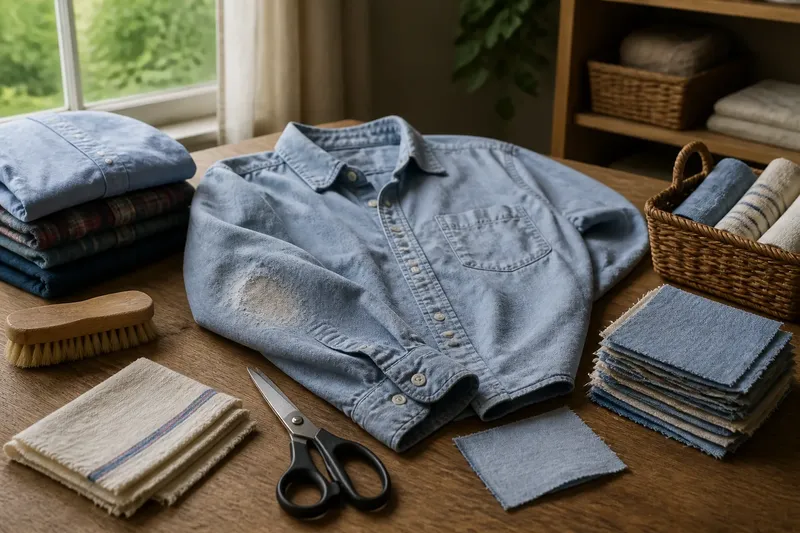
The most common mistake with a worn cotton shirt is treating every soft patch as a reason to throw it away. That can cost you a useful garment—or leave you with fabric too flimsy for another job. The second life of a worn cotton shirt depends on where the cloth remains sound, how it is assembled and whether another wearer could use it.
Set the shirt on a table in good light. Judge the body fabric, high-wear areas and construction separately. A shirt need not be perfect, but its next job should suit its weakest part. Wearing it, making household cloth and passing it on are different choices, not rungs on a ladder.
Read the fabric
Hold the shirt up to a window or bright lamp. Look across the front, back and sleeves for areas that have become noticeably thin, especially at the elbows, underarms, collar fold and cuffs. A faded patch is mainly a change in appearance; cloth that looks almost transparent or feels papery may tear during ordinary handling.
Do not rely on stretching a suspect patch as a diagnostic. Fabric construction, age and previous wear can make its response difficult to interpret, and pulling may worsen a weak spot. Instead, inspect it in good light for visible thinning, holes, frayed threads or a change in texture. Treat uncertainty as a reason to choose a gentler next use, not as proof that the fabric is sound or damaged.
Stains deserve a separate judgement. A faint mark on the hem may not matter to a future wearer, while cooking oil or paint across the front can rule out an easy hand-me-down. For household use, consider whether a mark could transfer to a surface or make the cloth unsuitable for its intended job. Location and character matter more than the mere presence of a stain.
Check the construction
Buttons, seams and hems show whether the shirt remains a coherent garment. Look for loose stitching at the shoulders and side seams, a fraying button placket, split cuffs and a collar that has lost its shape. Intact seams and a firmly attached collar can still make a shirt wearable even if its colour has dulled.
Construction also affects what remains useful after cutting. A roomy shirt with broad, uninterrupted panels offers more cloth than one crowded with pockets, pleats or decorative stitching. A pocket can help when wearing the shirt, but may catch on a cleaning cloth or leave an awkward lump. Keep the parts that help the next use; there is no need to preserve every seam or fastening.
Fibre feel offers practical clues. Cotton poplin tends to be smooth and light; flannel is brushed and softer; a heavier twill has more body. These are distinctions, not quality rankings. Smooth cloth may suit glass or polished surfaces, while textured fabric can work for general dusting. If the care label is missing, choose a use that does not depend on knowing the exact blend, and follow any remaining manufacturer instructions.
Three useful routes
Keep wearing it
Continued wear suits a shirt that remains comfortable, holds together at the seams and has no visible weakness likely to open during normal movement. Fading, a softened collar or a repaired button need not rule it out. It might become a work shirt, a gardening overshirt or a casual layer, if that suits the wearer and the garment’s condition.
Consider where you would wear it. A loose cuff or thin elbow may be tolerable at home but distracting elsewhere. If the shirt restricts movement, rubs at the neck or needs constant adjustment, its remaining wearability is theoretical rather than useful. Here the question is whether it earns a place in regular use as it stands.
Cut it for household cloth
Repurposing suits a shirt that no longer works as clothing but still has clean, usable panels. Remove buttons and any stiff collar or cuff sections that could scratch a surface. Cut around holes, deep stains and weak seams, then keep sound pieces in shapes that are easy to fold and store. A broad panel can become a general-purpose cloth; smaller pieces can serve for dusty corners or messy jobs.
Choose the job before cutting. Cotton cloth may work for wiping hands, cleaning tools or absorbing a small spill, but not every old shirt suits every surface. Rough fabric can leave lint on glass, and oily cloth can spread residue. Wash the pieces first, then try one on an inconspicuous area of a delicate surface to check for lint or colour transfer.
It is not worth turning every scrap into a household supply. If a shirt yields only tiny, weak pieces, or you already have more cloths than you use, further cutting makes the pile harder to manage. Keep only pieces with a clear job.
Pass it on
Passing the shirt on suits a garment another person could wear without first having to solve major problems. A clean shirt with sound seams, working buttons and no substantial damage is easier to offer as wearable clothing. Be candid about wear: a faded but sturdy shirt differs from one with a thinning back or persistent stain.
Check what the recipient or local reuse service accepts. Some take wearable clothing but not fabric scraps; others may have textile collection for items unsuitable for resale. Do not put a worn-out garment in a clothing donation bag assuming it will find another wearer. If no local route accepts it, use the sound sections at home or follow local textile-waste guidance.
Which route fits best?
Can a faded shirt still be passed on?
Yes, if the fabric is sturdy, the seams hold and the shirt is clean and wearable. Describe the fading when offering it, and check that the person or service accepts used clothing in that condition.
What if only one area is worn?
Let the weak area guide the next use. If it is small and the shirt remains comfortable, it may still be worn casually; if it compromises the garment, cut around it and keep sound panels for household cloth.
Is every cotton shirt suitable for cleaning?
No. Very linty, stiff, oily or colour-running fabric can be a poor match for delicate surfaces or light-coloured items. Wash a proposed cloth and try it on an inconspicuous spot before using it more broadly.
When should the shirt leave the home?
Let it go when the remaining fabric is too weak or dirty for a useful household job and no textile route is available. Keeping unusable scraps out of habit does not give them a second life.
A simple choice
Say you have a soft blue cotton shirt with a faded collar, a sound back and a visibly thin patch at one elbow. You check the seams and find them intact, but decide the elbow could open during wear. You keep the shirt out of regular rotation, remove its buttons and stiff collar, then cut a broad piece from the sound back. After washing it, you try the cloth on an inconspicuous surface; if it leaves lint or colour, you reserve it for a less delicate job. The remaining sleeve is too weak to be useful, so you check local textile guidance rather than storing it indefinitely. The result is one useful cloth, not a claim that the shirt is fit to wear.
For the second life of a worn cotton shirt, decide from the strongest useful part, not from its age or overall appearance. Keep it whole when it still serves a wearer, cut it only when its panels have a job, and pass it on only when its condition is clear. That distinction keeps useful material in circulation without turning every old shirt into another thing to store.